|
The Varsity Club was established
in 1888 and historical records at University of Auckland record
there was a rugby club in the 1890's, but it had to be unanimously
resuscitated annually... and new colours had to be chosen
to give the thing a fresh start... upon in 1906 when the Council
agreed to the students' suggestion of heraldic blue and silver.
Gallaher Shield (Premier) Championships.
More »
Colin Maiden Memories. More »
From these uncertain beginnings a club has evolved that provides
great spirit and camaraderie for its members, intense pleasure
and occasional frustration for its followers and good healthy
fun for all involved.
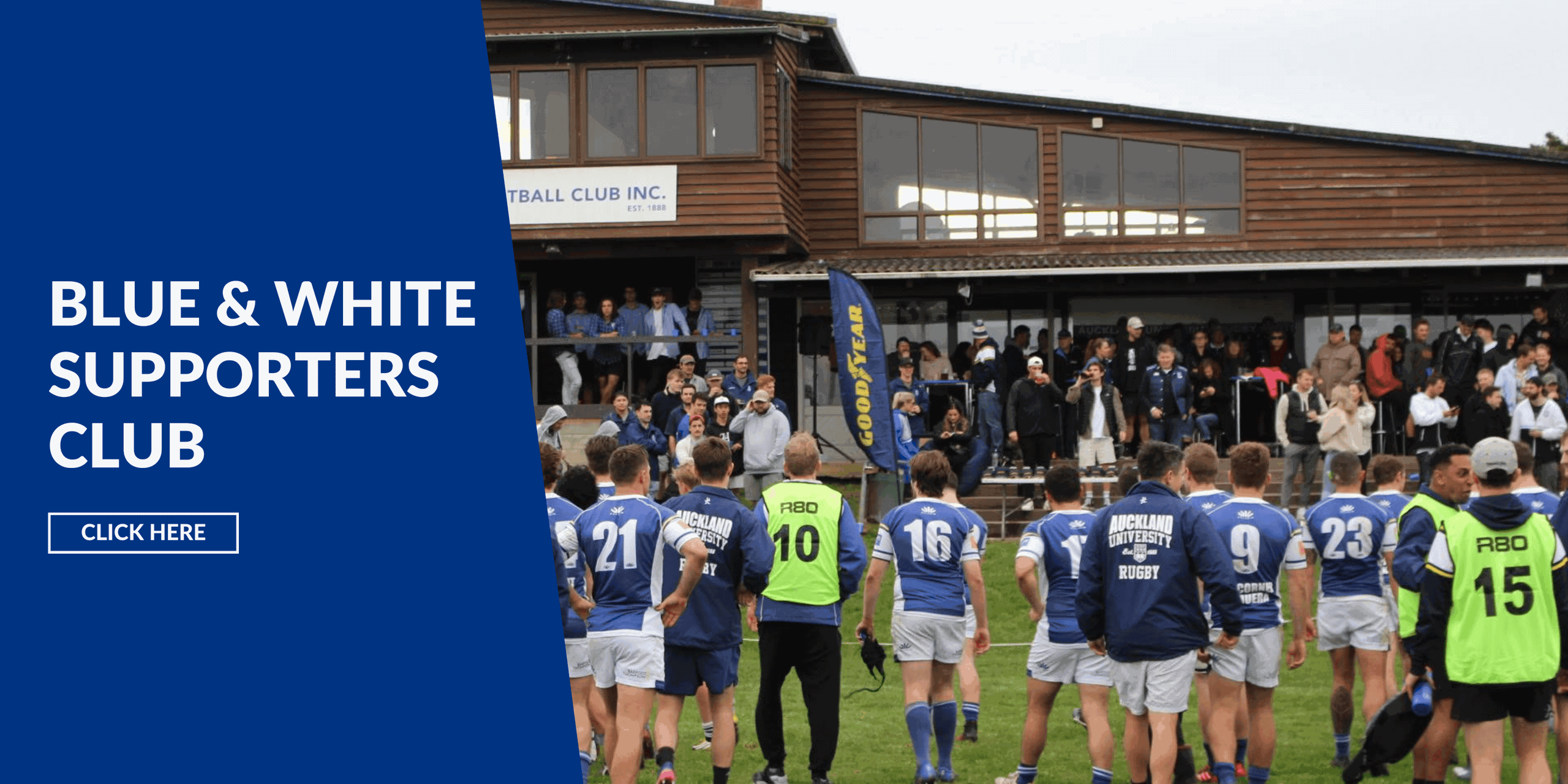
The award winning clubrooms besides the main rugby field
at Colin Maiden Park were built in 1977 and provides members
and supporters with a social facility that is possibly better
than any rugby clubroom anywhere.
Registered University students who play for the club qualify
for NZU selection with many famous names making their first
impression on the representative scene as part of an NZU side.
Gallaher
Shield (Premier) Championships
| |
Captain |
Coaches |
Manager |
| 1914 |
Frank Wilson |
|
|
| 1916 |
|
|
|
| 1918 |
|
|
|
| 1928 |
NC Jenkin |
RB Hardy |
|
| 1933 joint winners |
KD Anderson |
AH Keene |
|
| 1944 |
RL Jones |
LO Lesborough |
|
| 1949 |
Bryce Rope |
Trevor Berghan |
|
| 1952 |
Bryce Rope |
Dr Pat Fox |
|
| 1955 |
Dave Ludbrook |
Neil Laurence |
|
| 1956 joint winners |
Dave Ludbrook |
Neil Laurence |
|
| 1957 |
John Graham |
Neil Laurence |
|
1966
|
Neil Cullimore |
Mayne Smeeton
David Caughey |
Brian Williams
Tony Aston
Colin McLean |
1971
|
Neil Cullimore |
Barrie Hutchinson |
Ian Howard
Peter Johnstone |
| 1974 |
Dave Syms |
Bob Graham |
Kevin O'Shannessey |
1984
|
Grant Dickson |
Graham Henry
Graeme Halse |
Alan Calvert |
1987
|
John McDermott |
Ken Baguley
Tim Burcher |
Simon Johnston |
1997
|
Scott Kirk |
John Hunt
Jim Wyatt |
Simon Johnston |
| * The first of 14 Gallaher Shield victories
was in 1928. The first three Auckland titles in 1914,
'16 and '18 were prior to the establishment of the Gallaher
Shield, named after captain of the 1905-06 Originals Dave
Gallaher. University has won 17 Auckland senior championships. |
Colin Maiden
Memories
COLIN MAIDEN PARK: THE BACKGROUND
The following was written by Sir Colin Maiden in 2006-07
and provides an insight into the development of sporting facilities
at Auckland University. Maiden was Vice-Chancellor of Auckland
University from 1971 to 1994. The playing fields at Merton
Road (previously known as University Park) were renamed Colin
Maiden Park in 1994 in recognition of Sir Colin's vision in
ensuring that sporting facilities are an integral part of
a complete tertiary education.
STUDENT AMENITIES AND SERVICES
One of my first emotions on returning to the University was
of disappointment in seeing how poorly off it was for student
amenities. The Student Union complex, designed by Miles Warren
of Christchurch, was nearly complete and provided adequate
catering and bar facilities, a bookshop and Students Association
offices. Also there were Student Health, Counselling and Accommodation
services, but no theatres or recreational facilities. O'Rorke
Hall and International House were the only two substantial
halls of residence.
The Auckland University Students Association
(AUSA) was a legal entity in its own right with its fees,
including a buildings levy, collected by the University. AUSA
managed the Student Union complex under policies determined
by the Student Union Joint Management Committee of Council.
I always had difficulty in understanding why AUSA insisted
on managing the catering facility, which was a very demanding
business, rather than concentrating their efforts on student
clubs and other activities.
In February 1971 I addressed the students
in a packed Quad of the Student Union on, 'The University's
Role and Growth.' In particular I said that I would like to
see more student facilities, but these would be a few years
away. Not long after Bill Spring, the student President, asked
if I could help to get a theatre for the students and the
University. I inquired as to what was the problem and was
told that it was a money issue. The AUSA had monies available
from their Building Fund and the University had the proceeds
from some endowment properties, but this was not enough to
complete the project.
On my first visit to the University Grants
Committee in Wellington I decided to raise the matter of the
theatre. I was in my "honeymoon period" and I thought
they would want to start the relationship off on a good footing
and try to be helpful. My intuition was right and I came away
with a commitment from the UGC to provide a grant to meet
the financial shortfall.
I returned to Auckland buoyant with my success
only to be brought down to earth with a terrible thud. In
my absence the first issue of the year of Craccum, the student
newspaper, had been published and in it were three rather
nasty articles attacking my address to the students. The authors
were Stephen Chan, Editor of Craccum, another student, Sue
Kedgley, and Wystan Curnow, a lecturer in the English Department.
I was hurt and my confidence in public speaking, which was
fragile at the time, took a knock which lasted for some time.
Perhaps the authors were just letting me know who was boss!
I fronted Stephen Chan and Sue Kedgley in the AUSA offices
about their remarks and I think this helped. In particular,
Stephen Chan became very friendly and many years later, as
Dean of Arts at the University of Kent in the UK, he recommended
that I sit on an advisory body to the University. Looking
back on my address to the students I don't think it was too
bad!
The formal approval of a grant of $110,000
from the UGC for the theatre came through and detailed design
began. The building was to have a main auditorium seating
400 and a 100 seat workshop theatre. Construction started
and nearly every day I would walk around the site reviewing
progress. The complex was opened in November 1973 and named
after my predecessor, Dr Maidment, who was present at the
ceremony. The President of the Students Association, Mr Ed
Haysom, said, "The name chosen expresses the gratitude
the Association has felt over the years for the interest shown
in students by Dr Maidment." The success of the Maidment
Theatre through the years has pleased me greatly.
I was enthusiastic to obtain better recreational
and sporting facilities for the students. When I arrived there
were no such facilities on campus but there were two playing
fields available to students in Shore Rd. The Chancellor,
Henry Cooper, informed me that the Centenary of the Auckland
Harbour Board was coming up and suggested that I talk to their
Chief Executive, Bob Lorimer, about the University's desire
for an adequate playing field complex. I met with Bob Lorimer
and Gordon Burgess, a former New Zealand representative cricketer,
in their offices and told them my tale of woe. Their response
was very positive. They told me that the Harbour Board was
planning to announce certain community-oriented initiatives
to celebrate their Centenary. One of these possible initiatives
was the development of a marine park in Hobson Bay. They suggested
that a University recreation area, on reclaimed land at the
southern end of the Bay, could be incorporated into the plan.
I was delighted with the suggestion. On the way out, I happened
to mention that I was interested in broadening the subjects
offered by the Faculty of Commerce and, in particular, was
looking for support to fund a Chair in Business Studies. Bob
Lorimer thought this was a good idea.
The Auckland Harbour Board duly announced
their Centenary projects and they included both the University
recreation area in Hobson Bay and $50,000 over five years
for the establishment of a Chair in Business Studies. The
University Council was very grateful for these gifts. The
Chair in Business Studies was advertised and Dr Brian Henshall
took up his appointment in 1973. I knew Brian in the US when
he worked for the Aerospace Corporation in San Bernadino,
California, and had encouraged his application for the position.
The University's site consultants, Kingston,
Reynolds, Thorn and Allardyce (KRTA), started work on the
design of the playing field complex in conjunction with the
Auckland Harbour Board. A major complexity of the marine park
project was that an Act of Parliament was required to permit
reclamation of the seabed. It was not obvious that this Act
would be approved. Also, as time went by, the opposition to
such a reclamation started to mount, both within and without
the University. After a while I concluded that the odds were
against the project ever coming to fruition so, on the quiet,
I had our site consultants start to look at the possibilities
at Tamaki.
In 1944 the Auckland University College purchased
120 acres of farmland at Tamaki for £14,200 for a new
University site. The University funded the acquisition from
the sale of rural endowment lands. At that time the future
of the University, on an inadequate Princes Street site, was
uncertain. The purchase led to bitter rows over the site on
which it was to develop and the battle continued unabated
until 1960 when it was decided to stay in the city. When I
took up my appointment the University still owned the property
which, at that time, resembled a wasteland of noxious weeds
and scrub.
Our site consultants concluded that a playing
field complex at Tamaki was a viable proposition, subject
to zoning and various other conditions. Also I had met with
Rob Fisher, Rob Hargrave and Ken Baguley from the University
Rugby Club and obtained their support for a development at
Tamaki. Meanwhile the opposition to the Hobson Bay project
was increasing, particularly within the University. The day
came when the matter was to be considered by the Senate and
the opposition, including by now AU SA, was ready for a fight.
I moved from the floor, "That subject to finance, zoning
and other required approvals, the University playing field
complex be developed on the Tamaki site and the Hobson Bay
project be abandoned." There was a stunned silence. Professor
Val Chapman, Assistant to the Vice-Chancellor (Buildings and
Site Development), slowly rose to his feet and seconded the
motion. I called for discussion. My memory is that there was
either none, or very little, so I put the motion and it passed
unanimously. Council endorsed Senate's recommendation.
The problem then was how to finance the project.
In the end the University Grants Committee provided a grant.
My old AGS school friend Don Dick, who was Chief Executive
of Alltrans, asked to see me and this led to the University
selling his company twenty acres of land at Tamaki for $1,000,000.
Finally the Public Trustee agreed to contribute $1,000,000
over several years from the Auckland Education Reserves Endowment,
more of which later.
The new 40 acre sports complex at University
Park was opened in 1978. It consisted of five rugby fields,
two soccer fields, three cricket pitches, two hockey fields,
a softball diamond, an athletic track and a splendid clubhouse.
Over 10,000 native trees and shrubs in associations of coastal
species were planted. Not long after the opening six grass
tennis courts and the Auckland University Rugby clubhouse
were completed.
A number of years later, in the changing
rooms of Remuera Rackets Club after a game of tennis, Peter
Wilson, President of Auckland Tennis, asked me whether I knew
of any suitable land for a tennis park. I told him that the
Auckland City Council owned some land adjacent to University
Park, also that the University may be willing to sell some
excess land in the area. This conversation led to the construction
of Vodafone Tennis Park. Again some time later, after a board
meeting of Independent Newspapers Ltd, I was talking to Ian
Wells, General Manager of Wellington Newspapers and President
of New Zealand Tennis. He told me that NZ Tennis was looking
to fund an indoor tennis complex in a major centre. I encouraged
him to consider Vodafone Tennis Park as the venue for this
development.
To my delight both the indoor complex and
the headquarters of New Zealand Tennis ended up at Vodafone
Tennis Park. One of the end results of all this was that the
tennis courts on University Park weren't really needed and
have now been built upon.
In recent years a Sports Science complex
and a gymnasium have been added to the park. Naturally I am
very proud to have my name associated with the park. This
was a decision of the University Council at the time of my
retirement as Vice-Chancellor in 1994.
Planning for the recreational centre on the
Princes Street site started in early 1973. It was a bold design
that included seven squash courts, a main gymnasium with seating
for spectators, a workout gymnasium, a martial arts gymnasium,
a modern dance studio, staff and student offices and changing
rooms. The campus badly needed a "heart" for students,
other than the catering complex, and I was counting on the
recreation centre to provide this focal point.
Russell Bartlett was President of AUSA in
1973 and I received good co-operation from him and AUSA in
planning the centre and other student facilities. I should
note that co-operation from the students was not always forthcoming
during my years as Vice Chancellor, but it was very good in
the early 1970s. Like the Maidment Theatre, the problem was
how to finance the Recreation Centre, ultimately to cost $2.2
million. The UOC could be expected to subsidise the AUSA contribution
but this would not be sufficient in total. As it turned out
the remainder was obtained from the Auckland Education Reserves
Endowment and how this happened may be of interest.
During my attendance at Student Accommodation
Committee meetings, I observed that sometimes it would be
suggested that monies (generally small) from the Auckland
Education Reserves Endowment be used for some purpose or other.
After a while I started to ask questions about this endowment
and asked to see the original Act of Parliament. I found out
that the endowment had been set up in 1912 for the establishment
and maintenance of hostels for the students of Auckland University
College and that its main asset was the block of land bounded
by Queen, Victoria, Elliott and Derby Streets. The endowment
was controlled by the Public Trustee and the income from the
buildings was several hundred thousand dollars per year. For
years the Public Trustee had been adding most of this income
to retained earnings with the intent of redeveloping the site
in the future. My interpretation of the Act, as amended by
the "Reserves and Other Lands Disposal Act 1949,"
was that the income could be used for the students on a broader
basis than just for accommodation purposes.
It was arranged for the Public Trustee to
visit the University where he was presented with the plans
for the Recreation Centre. I emphasised how deficient the
University was in recreational facilities for students and
pleaded with him to release his hold on the endowment's funds.
The Public Trustee considered the matter and, generously,
allocated several years' income to the financing of the centre.
As I noted earlier, the Endowment also contributed to the
financing of University Park.
The Recreation Centre opened in 1977 and was an immediate
success with the students. It really did provide a heart for
the campus. The first "trial match" on the squash
courts was between Steve Hollings, the Physical Recreation
Officer, and myself and was photographed for the University
News.
Student accommodation was much improved during
my years at the University with the opening of Grafton Hall,
a Presbyterian, Methodist, Congregational Foundation project,
in 1971, the Collingwood student flats in 1975, the Parnell
and Whitaker Place student flats in 1987 and the redevelopment
of O'Rorke Hall in 1989. Once again the Auckland Education
Reserves Endowment helped significantly in the financing of
the O'Rorke Hall redevelopment.
Also, through the years, the Student Health
and Student Counselling services improved significantly and
provided effective assistance to students. Through this period
I had very good assistant Vice-Chancellors (Student Services)
in Professors Barney Sampson, Marie Clay, the University's
first woman Professor, and Con Cambie.
When I retired as Vice-Chancellor I thought
that the University had very good student amenities and services,
although there was still work to be done. In particular a
new Student Amenities complex, on the corner of Alfred and
Wellesley Streets, was being designed. The Kate Edger Information
Commons and the Student Commons have since been completed.
My only disappointment was that 1 had never been able to convince
AUSA to support and help fund a swimming pool.
|